Big Country
On June 19th 2019, myself and my family left Brisbane for a seven month trip around Australia. These are some notes on the journey. It is not a journal or diary as such, more notes and observations of our time away.
On June 19th 2019, myself and my family left Brisbane for a seven month trip around Australia. These are some notes on the journey. It is not a journal or diary as such, more notes and observations of our time away.
The last few weeks end up being like a holiday at the end of the trip – moving from Melbourne along the South Coast of New South Wales to Sydney and eventually to my family’s home in Scone. We drive through an endless pall of bushfire smoke, with much of the south east of Australia being swallowed in unprecedented blazes.
We finish the final leg to Brisbane in two cars, with additional passengers. I drive with the dog Tex, while Sandi is with the boys along with Gary, the cat.
It’s close enough to a ten-hour drive, and throughout I am filled with strange mix of melancholy and excitement, a curious pudding of cream and spice.

The house looms tall and familiar on the top of the hill in Brisbane. We stand as a group of four outside, and hug. There’s a sense of ‘we did it!’ but that feels unusual because the trip was never a challenge to conquer. This is more of a consciousness that right now, as this little non-descript huddle on a street, we are a family that has somehow changed inside while more or less looking the same from the outside. And this moment, like the multitude that have passed in the last seven months, can never be repeated.
A strangled meow comes from Gary in the cat cage.
We go in and walk through the empty rooms, hearing the floor boards shift, door hinges creaking, steps murmuring. These are sounds we had forgotten we had known. It smells slightly antiseptic – the tenants only moved out the night before, but it’s unmistakably home. We forget where lights switches are and what showerheads we have. I need a three minute tutorial from Eddie on how the work the television again. But overall, it’s familiar.
There’s much to be done in moving back, going back to work, preparing kids for school so inevitably it feels like a split second and we are back into this urban life again. Kids are taken to sports, dropped for sleepovers, rubbish is put out and the mower rumbles back into life.
Gary does an enormous wee all over our bed that we had only just reconstructed and made.
While all this movement and sound surrounds us, the places we have been and the spaces we have entered just carry on. Birds still flit and dance around the Gregory River, dolphins still ripple and shimmer through turquoise waves in the Bight, stones bake red and twisted in gorges in Karijini, brilliant sparks of vivid colours explode in reefs along Ningaloo, dust still boils outside of Mildura and the endless tides still surge. There is no start and end, no time on or off for the unending beauty of nature. It cares not for the artificial obstacles we build, the arbitrary times we schedule to meet, the unnecessary things we have to have.
It just is.
It continues its unavoidable existence, as it will long after we have vanished. It is the darkness that remains after the last bottle from the most outrageous party of all time slowly clinks into the gutter and the glitter falls softly to the floor.
Whatever we do, she will always be.
Despite the sense of being back to regular life, there is a lingering light in us all that refuses to extinguish. Like the soft depth of the evening gloaming, it creates a new perspective and we reacquaint with the familiar from a changed viewpoint. A sense of good pervades, that we are happy, enthused but overall, unbelievably fortunate. We are the lucky ones.
While I write, Gary slinks between my legs and drops at my feet, a soft hum coming from deep within.
Home.
The contrast is absolute.
Today we walk through a fecund eucalypt forest in the Otway National Park. It’s a sharp, winding 500-metre climb through grand, goal post straight gums, dotted with occasional grey bulges that sporadically stretch a rear leg and scratch behind a furry ear. They are koalas, still electrifying to witness in the wild.
We walk in silence towards a lake that is nestled in the green. The hush is partly due to the possibility of spying another of Australia’s rare treasures, the platypus that is rumoured to call the water of Lake Elizabeth home, but it is something else as well. There has been some sort of wordless agreement struck as we entered the thick foliage, a sombre contract of mute respect. The boys, normally with some intrinsic requirement to fill the void with unreliable cricket facts or bodily functions, are also gloriously wordless. Some behavioural expectation has been transmitted and we have all received.
Above and below us on the track, the sticks and plants emit sounds of movement, raspy scratching’s as tiny birds flit and scurry after invisible quarry. They hop and buzz from one spot to another, tilting their heads and ruffling their tiny feathers, hearts fluttering in their ceaseless, energetic industry. All the while, the great gums soar above us, reaching like a child trying to reach the top shelf in a cupboard.
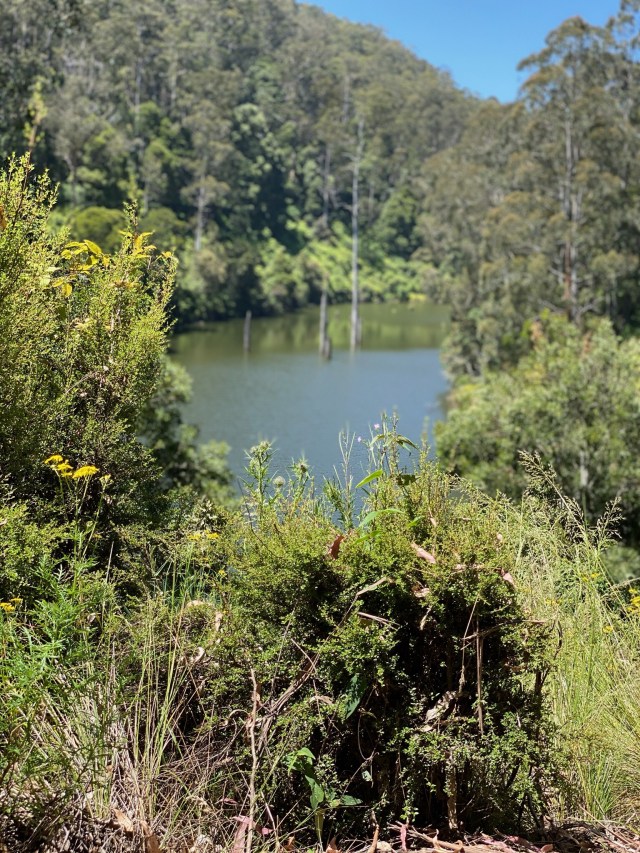
We settle on a bench that is sunk into the hillside, overlooking the lake. We see no platypus, but several ducks idly float on the surface, the gentle breeze warmed by the sun that is high, but not hot, wraps itself around our faces. The burr of nature continues around and we are all, for a moment, something that is rare, and thus, precious. We are content.
We have climbed from the Great Ocean Road, that famous thin band that grasps the edge of the country, grimly holding onto the precipitous mountainside, but at any moment looking like it may tumble into the swirling Southern Ocean that ceaselessly hammers below.
The road climbs and falls, and twists like a giant black snake baking on the earth. Along it ride the cars, motorcycles, buses and vans filled with the excited babble of the millions who visit yearly. They stop at the small roadside turn-offs, cars angled to fit around the great coaches, and tumble out. Poses are struck, buttons are tapped, and they return to the commanding beast that sits in the heat, engine bubbling. A cool rush of air-conditioned wind washes over you as you pass the open door.
At the Twelve Apostles, the most famous landmark of the road, it feels like a busy market square. The apostles, now only numbering seven (or eight if you count a rocky stump left behind by the last to tumble into the water), still provide a grand backdrop. The thin headland along which you walk is lined with hundreds trying to find the perfect shot. Ironically, the ultimate photograph appears to be one without any other people in it, as if the photographers are somehow experiencing the breathtaking scene by themselves, in isolation. At one point as I am absorbing the vista, I am gently tapped on the shoulder and asked to move out of the way by a small Chinese woman. She is courteous, but determined. She gets the shot.

Of course, by being here, we are part of this. And of course, I have done the same crawling over landmarks overseas, part of the horde. And despite the swarming numbers, the sight of the jagged pillars standing in the punishing ocean is still impressive. However, in time when I think back to this part of the journey, it will be that small wooden bench perched above the olive, rippled lake and that wonderful sense of being that will fill my mind.
You can’t live without hope that things will change for the better
You can’t live without the dream of someone reading your letter
– Colin Hay, Next Year People
‘It’s a dust bowl.’
These are the parting words from our host in Adelaide when we mention we are heading to Mildura that day.
I only take cursory notice; we’ve been in ‘dust bowls’ before. It’s our term for dry, arid campsites or barren caravan parks, dotted with shimmering vans or flapping, exhausted tents blistering in the sun. Occasional puffs of dust, fluffy drifting clouds, saunter across the space as new arrivals creep in. The dirt sticks to your feet, crusty on the dried edges of your sole.
We start the car and climb in, expecting some heat and crackle, and depart.
It’s a pleasant drive, initially through beautiful tree-filled hills that crown Adelaide, but there’s an edge with the pressing heat and I find myself doing that head shaking, clicking sound thing and commenting on the risk of fire. We turn west. A few hours in, I notice a distant orange smudge on the horizon.
We’ve had dust storms before and spit out the dirt
We’ve had droughts before but none quite like this
– Colin Hay, Next Year People
It takes a while before I realise the smudge is dust. A huge sheet of hanging powder rises from the line of the horizon. It doesn’t look like those wild, violent, cumulus dust storms that roll across a town, gently swallowing what stands in front. It’s haze, and although still distant, menacing and thick.
Outside the land stretches far as it flashes past us. Some of it looks like unimproved scrub with low-lying, resilient plants stubbornly surviving without it seems, any water whatsoever. Other sections are endless paddocks that have been cultivated at some stage. But everything is like ground bone and powder dry.
As we travel, the wind increases for no discernable reason and there are small drifts of dust dancing across the road. The atmosphere has changed from clear to a badly done fake tan, copper and orange. Another car has stopped and I see the shirt of the male driver who has stepped out of the car being violently ruffled and folded by the wind.
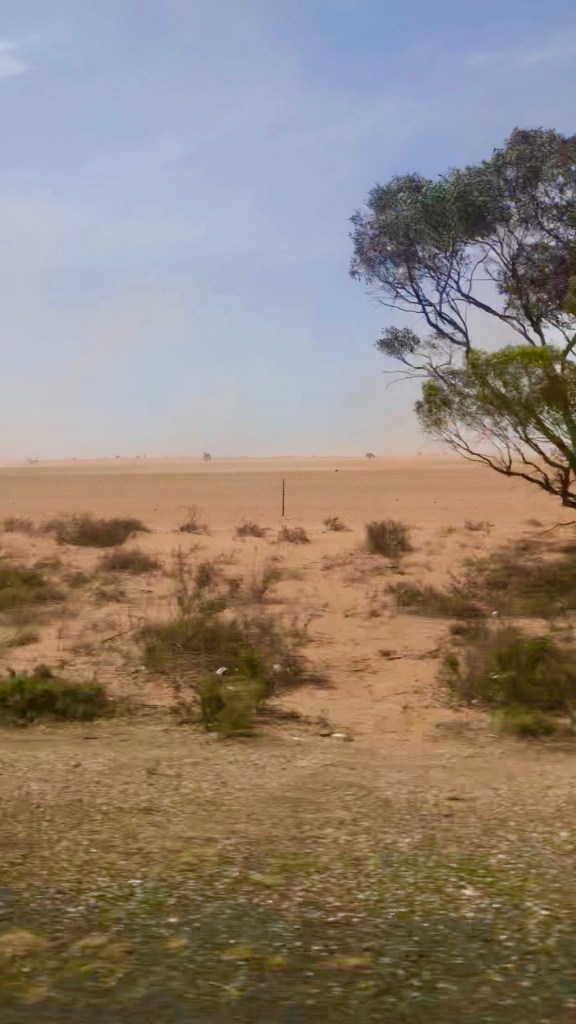
It gets stronger, and all around us, dust is now being raised and tossed. It’s not frightening or violent, but almost sadly systematic. The bent and muddled fencing that once ran straight for miles is now just the barrier that holds great drifts of soft dirt piled neatly on either side, like never ending sand dunes. At times, the fence gives in and disappears beneath the soil. In the middle of this apocalyptic scene, I think, ‘what’s going on here’ and ‘isn’t this a disaster?’
We arrive in Mildura, leaving the dust behind, but it only takes a glance in the rear view mirror and the great cloud remains. It stays all afternoon. By morning, looking to the west, it initially appears clear but the winds develop and by lunch, the rusty shadow reappears.
Dry endless plains and we suffered the worst
Are we being punished or are we just cursed
– Colin Hay, Next Year People
I do what the privileged confused do and Google, and discover Mildura has lived with dust for decades. There have been some astonishing days (with accompanying photos) where the town has been subsumed in the topsoils of the country that surrounds it. I also recall my dad telling me of days when he was a child growing up in western New South Wales and his mum, my grandmother, closing every window, louvre and door as a huge shadow approached. Dust has been raised before and will continue to be.
The Dust Bowl in America, fascinating in its environmental portent and social impact, is close to a century past, but the devastating images of Dorothea Lange and others still burn deep. The edge of Mildura is not depression America, and people are not leaving following dreams of fortune dropped from the sky (so powerfully described by Steinbeck), but it’s still shocking to witness such powerful natural decay. But after the shock, another feeling pervades. It’s a heartbreak borne from an overall sense of defeat.
Next year everything will come good
The rains they will fall and we’ll dance on the hood
We’ll fill up our bellies with plentiful food
We’ll eat drink and be merry
Yeah next year people wait and see
We’re next year people you and me
Yeah next year people wait and see
We’re next year people you and me
– Colin Hay, Next Year People
The endless black ribbon stretches in front of us.
The Nullarbor Plain, an expanse cloaked in stories of endless nothingness, is an uninterrupted void topped with a highway that unravels flat and dead straight.
The road runs east from Western Australia, neatly meeting the inside of the Great Australian Bight near Eucla, just before the South Australian border. Here it tracks the sheer, vertiginous edge of Australia. Plummeting into the deep blue the wild eroded cliff faces, the obstinate perimeter of our land, stake their place in the surging water with breathtaking force.
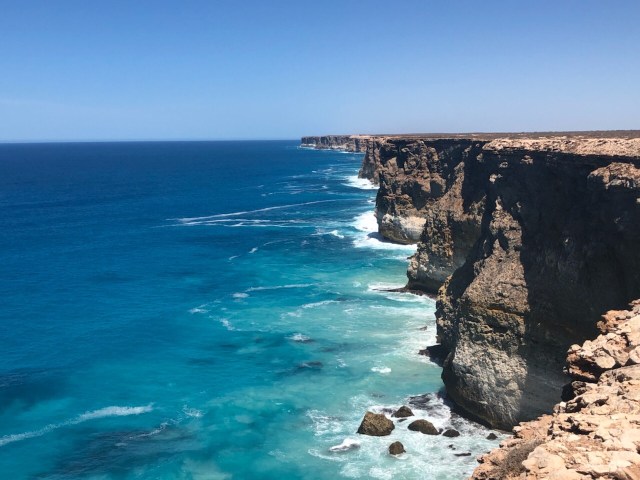
When I was a kid, I remember once going to a beach from our inland farm and seeing some rocky coastline, some little bay. I recall smugly thinking to myself ‘oh, that’s that bit that goes in on the map of Australia’, mistaking some non-descript stormwater outlet in Foster with the Bight. No mistaking this time.
While travelling this almost mythical section of road from west to east, it occurs to me that although it will be places, sights and experiences we talk about when we get home, stories that will become well worn, the road is actually the place we spend most of our time. Along the Nullarbor lie tiny communities, and I am reminded of the variety of towns, villages and hamlets we have encountered as we have travelled slowly around the country. At some we stop for lunch, hastened by flies or slowed by strange little shops full of oddities. Others we rumble straight through, just another car towing a trailer.
It’s impossible to get an accurate understanding of what places are really like with such a brief window into their existence, but it’s also impossible not to get a feeling. For some, it’s a sense of tiredness, a feeling that the time has past. Others renew and find different ways to continue, while others are fresh and shining with shimmering black rooftops side-by-side into the distance.
We’ve developed common phrases to describe the overall perceived prosperity of places as we have moved along. They are ‘looking good’ or ‘trying hard’, maybe ‘pretty quiet’ or the ultimate descriptor of a commercial nadir, ‘spooky’.
Speed limits can be a clue. If your town has slowly decreasing limits on its fringes – say from 110, to 80, to 60, to 50 and then, even 40, then you may well be in a flourishing locale. If, however, there is simply a reduction from 110 to 90, or worse still, no change at all, you’re in a small place that even road safety may have forgotten.
And so we come into Penong in the far west of South Australia. The map gives away little, just another dot near the end of the Nullarbor. However, as we approach, a sign tells us that Australia’s only windmill museum calls this little dot home, and we are instantly enthralled. This is the very type of civic innovation that we have come to admire, an indication of a town that hasn’t given up.
And so we wheel in, to a small paddock that is dotted with a wild assortment of windmills, the glistening silver blades circling slowly in the obliging warm breeze, the sun sparking off them as they turn. There’s a little shed with boards of information, revealing that the whole thing was born when the owners of the rural supplies shop and the caravan park decided the town needed something to grab traveller’s attention. Windmills were the obvious choice, with Penong having a history of reliance on the graceful spinning machines and their inherent pumping qualities due to the fact that it never bloody rains.
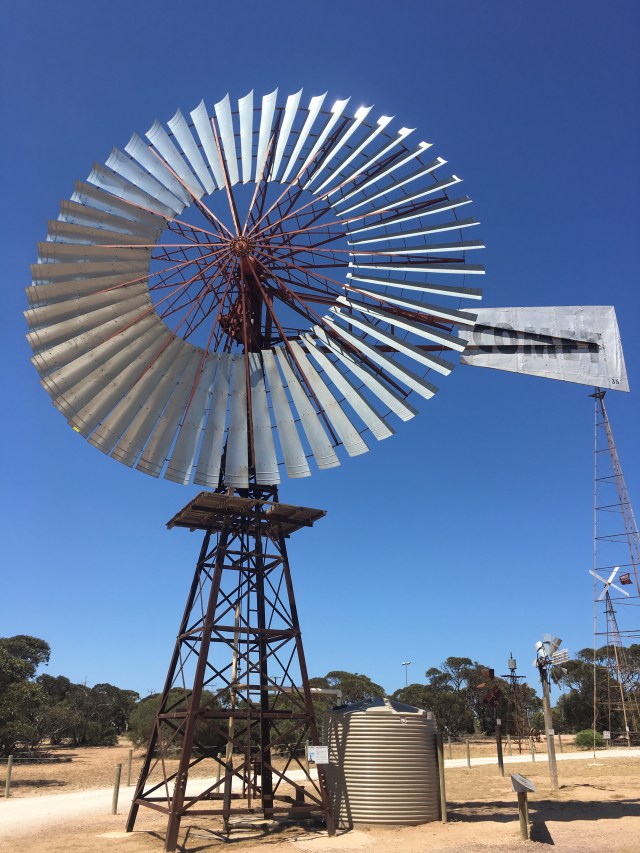
And so it began, and continues, and it’s wonderful. I am filled with nostalgia as I gaze up, reminded of the creaking machines we used to have on our old farm, held aloft by intricate towers of iron, rust brown. And the sound – they move slightly in the wind and the metal protests with a soft groan, there are small dings and dongs and the comforting soft whoosh of the hot breeze pushing it all.
And so Penong continues to live, nourished by lifeblood driven by the windmill ghosts turning in the middle of town. Of course, there are other factors that keep this town alive, but the spirit of community that something like this represents is obvious. Some towns feel like the love has left, the soul is broken and only the windswept shell remains. They are feather-thin and fragile. Others, like Penong, feel nurtured and needed, propelled by the hearts of those who call it home.
The morning opens heavy and grey. Dark smudges of cloud fill the sky, thick and stagnant, lighter in the east where the morning sun is filtered and confined to a dull constant. There is a sense of the suns presence, but the dense blanket has defeated the raging luminosity. All is damp with an enveloping weak mist, a soaking fog that creates tiny droplets that hang from leaves like miniature earlobes, somehow still glistening despite the drab, colourless light.
Against this murky, soggy panorama, the sand of Lucky Bay still sparkles vivid white, running from the dunes that are pocketed by green crags, across the beach and down to the tide where it is covered and revealed by the water.
The water… the clean, diaphanous water.
As the waves crest before they topple and break, it becomes translucent, transparent in its purity and bed of pure blanched sand. The water crashes onto itself, and produces a foam somehow whiter than the bleached bottom that it bubbles over.
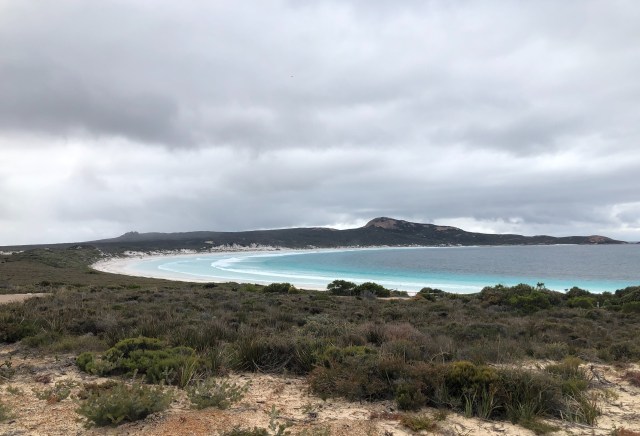
Across the bay, a headland overlooks. It rises sharply from the blue, the kinks and twists of its tortured evolution softened by the dark olive blanket of gorse and shrub. The thick band of green is crowned by an imperious chunk of bald granite, thrusting upward into the silvery sky, a petulant challenge. The protracted combat against wind and rain has rolled the great rocks shoulders to softened points, but there is still a grand stubbornness to its presence.
Nature warrants time and patience. It reveals a majestic whole created from detailed parts.
The bush that scarves the granite mountain exposes bursts of colour – flowers lilac, red and white, amongst greens that run from a yellow-khaki through to a dark, deep olive as if moving from the seed to the outside of a ripe avocado. Soft flowers of lucid colour erupt from gnarled, wind-strained branches that look like salt-faded chunks of rope twisted and bent.
A fiery orange-red flower, like six bright trumpets bursting forth, with the tips of the petals spinning back as if the shrill sound of the fanfare could be physically embodied. Another is an explosion of purple, perfectly mimicking a joyous detonation of fireworks. The grand old banksia flowers, the local variety actually called the Showy Banksia, demonstrating its ostentatious appearance. The beauty of this flower, actually made up of hundreds of smaller tubular flowers, is dependent on the violent destruction of fire which at once ends the lifecycle of many, but starts the existence of this majestic blossom. And one final fascination – a tiny white furry specimen that looks like hundreds of minuscule pipe cleaners, or strange little caterpillars, that when combined on the bush resemble a huge lamington covered in shredded coconut.
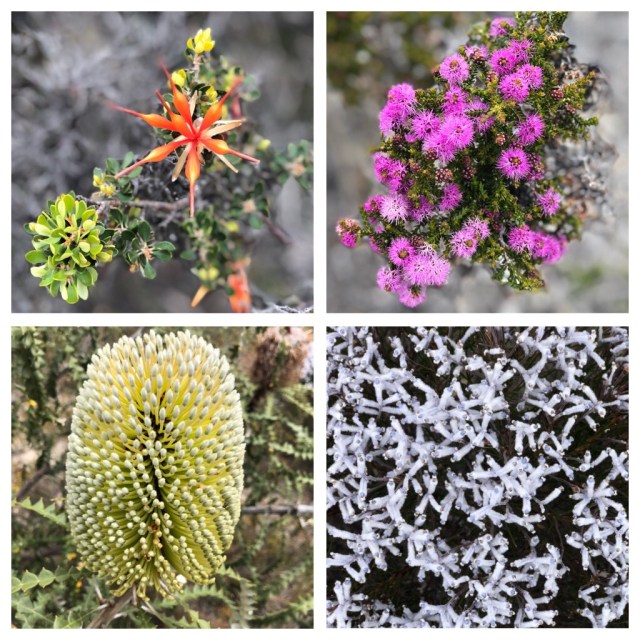
All vivid and complex when close, but then fade into the greater green from afar. It pays to bend, to stoop, to stop and to peer. There is no greater teacher of time and reward than nature.
Suddenly, the sun pushes through a crack in the clouds and the bay explodes into shimmering, dazzling silver. Still no soul walks the beach, it is deserted and alone. The water crashes, the sand dazzles and the bay exists, unconscious of its beauty. Lucky Bay indeed.
So here’s a nasty little gash in the West Australian coastline, where the ocean water surges and boils. The waves brutally invade the small beach before retreating again, only for the thin strip of sand to be reconquered by the next violent roller. The water, whipped by a constant south-westerly, heaves in before sucking back through deep channels that fill and empty with a steaming ferocity, hissing as the air rushes through the cramped spaces.
The beach itself is at the end of a tight gorge, the rocks wrapped in layers down the tight fissure that drains a now empty creek into the sea. From above, it’s like someone has thrust a blunt knife into the rocky coastline, taking the folded layers of stone and pushing them inland. The beach is framed by two shoulders of twisted rock; shoulders that defiantly jut into the water absorbing the constant drubbing, resolutely obstructing the oceans beating. The water strikes and shatters into sparkling droplets that refract the beating sun into thousands of small rainbows.
The jarring south-westerly pummels all.
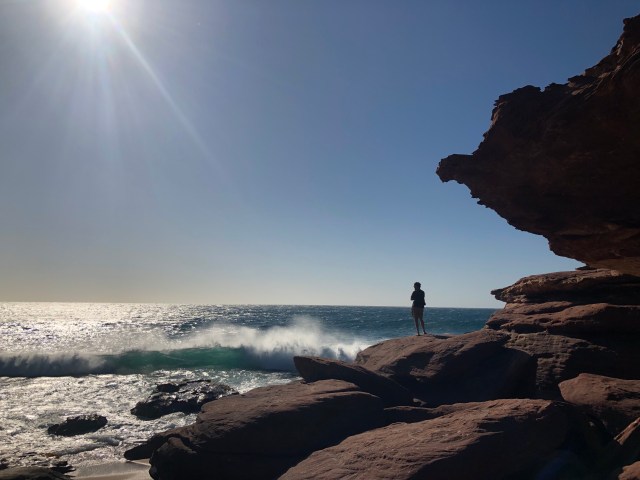
Suddenly Frank is running towards the water as a wave rushes in, his head down into the wind. I am sitting on the northern rock shoulder and within a beat, the time it takes for his spindly legs to run two or three steps, my imagination runs through an entire excruciating scenario.
I see him getting too close, the wave reaching out and latching around his ankles, tripping him and sending him bouncing down on the wet sand. The wave slurps him back into the blue, through a gushing channel that takes him under momentarily, before he surfaces briefly, gasping and spluttering and utterly terrified. He looks directly at me, into my eyes with a desperate confusion, and then disappears.
‘Frank!’ I yell, but the wind flings my words back over me, never to be heard.
The wave cracks just metres offshore and the water floods towards the beach. Something about the sound, the almost perceptible vibration from the force of water, stops him in an instant and he starts to reverse, laughing with excitement as the speeding white edge of the pushing water just touches his feet. The snowy froth kisses his tiny toes as he clumsily runs backwards, stumbling through the sand.
‘Back further,’ I yell again, standing and gesticulating with my arm making sweeping arcs. He sees me and stops laughing. There’s a moment of puzzlement, my tone and urgency making him think he might be in trouble. I run down and get close to his salty face.
‘It’s alright, you just have to be careful,’ I explain. ‘The water can be really powerful here, so no closer.’
He nods and races back up the beach to his Mum, and a hug.
Occasionally, it’s the smallest spaces that count. Your feet from the edge of a cliff, the gap between your fingers and a flame, the void between each rushing car that passes. We marvel at distance, the expanse of nature and the impossible horizon of space and beyond. But sometimes little gaps hold more than the universe.
The four of us are lying on our backs, with our legs on a shelf so that our calves and feet are above our heads. Eddie is on one side of me, Sandi to my right and Frank next to her. Eddie and Frank are dressed in astronaut suits. It’s a very small space, and it feels like we have been in some strange, painless car accident and all ended up sandwiched against each other wondering what the hell is going on.
We should actually be feeling like Neil Armstrong and Buzz Aldrin, as we are in the Apollo 11 simulator in the Carnarvon Space and Technology Museum, an experience that promises to take you into the world of space flight.
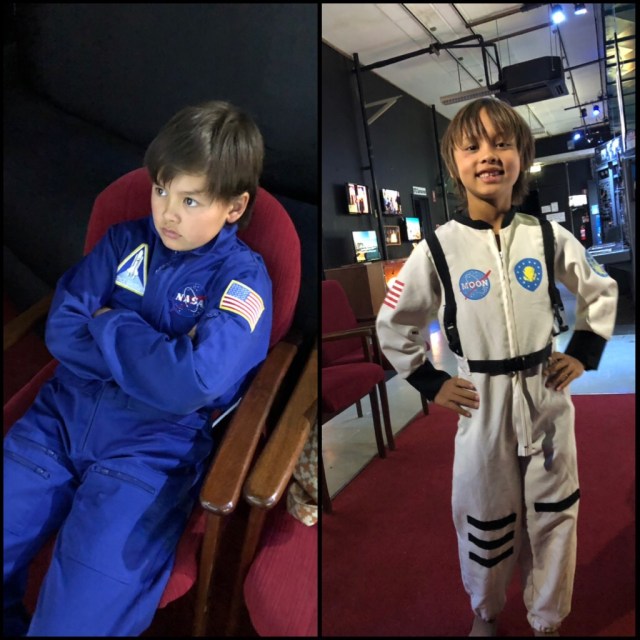
According to Nathan, the highly personable bearded volunteer, the capsule size accurately represents the dimensions in which those space pioneers from the 60’s actually operated. Based on the fact that Neil and Buzz actually walked on the glowing white satellite, it’s probable that’s where the symmetry ends, as the technology in this machine is a little flaky. I’m no rocket scientist (not the first time I dropped that Dad special on this day), but I’m fairly certain most of the instrumentation in the actual Apollo rocket wasn’t painted on.
Nathan thumps the door closed and we are locked inside.
Suddenly, the small screen above us bursts into life and is filled with the image of the Apollo 11, glorious and streaming in smoke and steam, on that bright, crisp day in July 1969. It’s the original footage, shaky but clear.
‘T minus 3 minutes and counting.’
It’s the calm, utterly American voice of the guy who counted the world down that day. He then steadily goes through processes happening within the unimaginably complex contraption, including updates from astronaut Armstrong who assures the flight control centre that everything ‘looks great’. Despite my cynical, somewhat predictable attitude towards the overall construction of the simulator, it’s thrilling.
It’s at T minus 2 minutes, as the second rocket chamber pressurises, that Eddie, through giggles says, ‘Stop, we forgot the Nutella!’ He cracks up hysterically and Frank does his thing, which is repeat the joke. “Stop, we forgot the Nutella’ he chortles, ‘that’s what Eddie said, we forgot the Nutella. He said we…”
“Quiet Frank, we’re about to launch,’ I cut in, probably too quickly, but by this time, I’ve bought in and I’m feeling it.
At T minus 1 minute, a third previously unknown chamber pressurises in one of the offspring, and the resulting funk wafts through the desperately small chamber.
‘Jesus Christ, someone’s broken the first rule of space flight!’ I exhort.
Having lived in what is only a slightly larger environment, be it car or tent, with a husband and two boys for the last four months, Sandi’s powers of identifying who is responsible with the faintest sniff are without match – she’s an olfactory freak. She immediately pins this as the work of Eddie.
‘Ed,’ Frank says in a rapid, concerned whisper, ‘everyone knows you never fart in a space suit.’
Although I can’t confirm the first absolute in terms of all people, he’s unquestionably correct about the suit part. Sadly, this outfit isn’t sealed and the miasma hangs like a brutish shadow above us, invisible but pungent.
Eddie has heard none of this as he is in fits of laughter. This is one of the greatest farts of his life.
Suddenly we have counted down, Neil and Buzz have literally rocketed into the atmosphere and the screen fades. Unfortunately, the same can’t be said for the stubborn, fetid mist that still occupies the cabin with us.
The capsule door swings open above us, and there is friendly bearded Nathan, staring down at us, although as we are lying away from him, he looks upside down. Despite the inverted appearance, there is no mistaking the moment he cops a nose-full.
‘Do I need to disinfect the chamber?’ he asks somewhat wearily.
‘I’m sorry but yes,’ giggles Eddie.
Eddie then crawls out of the cavity and formally apologises to the next astronauts, an older couple whose previous excitement about going where no man has gone before has palpably diminished. Meanwhile, Nathan is giving the compartment a decent dose of Glen 20, which courageously wins the battle and returns Apollo 11 back to full operating order.
Eddie and Frank peel out of their suits and we exit the building. I had hoped the boys would have left with a sense of awe, of genuine astonishment and a wanderlust that burned so deep that one day they too may travel to the edges of the solar system, driven by the memory of that three minutes in a small metal tube in Carnarvon.
Instead, they’ll remember a fart.
Little patterns have settled as we move across the country. I wake first and get coffee, the boys stretch and groan and creep up to where Sandi still lies and crawl in around her. Little patterns. We have sandwiches for lunch and Frank doesn’t have tomato but Eddie does. Little patterns. We do a grocery shop and we each have our own sections (I’m on meats), while Sandi remains as the literal mother ship to which we each orbit as she slowly meanders down each aisle. Little patterns.
Of these, some are expected, extensions of our everyday domesticity. But others are not, including Frank’s obsession with goal posts. Whenever we travel through a town, from small dust caked, two dog hamlets to humming capitals, Frank has his face against the window, eyes wide open, searching for the four toothpick uprights, two tall and two shorter, that make the distinctive shape of a set of Australian Rules football goalposts. If spotted, there are two immediate consequences.
First, a declaration.
‘That’s it,’ he announces ‘I could definitely live in Humpty Doo for the rest of my life.’ Or Darwin or Roper Bar or Halls Creek. Frank could happily ensconce himself in about 30 odd towns around Australia so far.
Second, a request.
‘Dad, can we stop and kick?’
At once, I feel that cold trickle of guilt. I glance quickly at the clock and do some mental arithmetic, which somehow always ends in a poor result for Frank, and with an automatic reflex utter that infamous two-word escape phrase.
‘We’ll see,’ I respond and drive on.
There have been times I have spotted posts and he has not, and I have resisted running an active decoy, somehow finding something fascinating about the bland, light industrial area on the other side of the car. But just as I am formulating the fictional history behind the specialist metal machining and bolt shop, he spots them, declares his plans of living in Mataranka for the rest of his life and pops the question.
Despite the poor conversion rate, he persists and his resolute determination is rewarded occasionally.
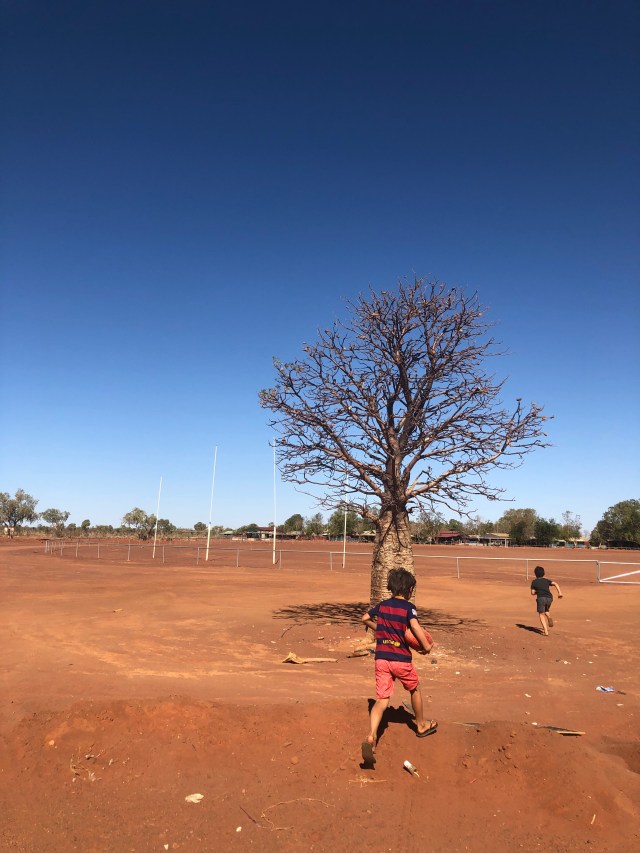
We have been running around Carnarvon for several hours shopping, getting water and attending to some minor mechanical issues and are finally heading back to the caravan park. We are hot, tired and in need of a shower when the posts appear. I check in the rear vision mirror and he locks eyes, with a pleading stare that skewers a huge nail with ‘shame’ etched on it side through my heart, so we turn in and fall out of the car.
Eddie and Frank run across the field shrieking in joy as if running on for a grand final, and I walk after. The grass is soft and cool under my bare feet; the breeze ruffles across the field. The zephyrs pick up the boys voices, both of which mimic the tone of excited sports broadcaster as they individually commentate their actions. Currawongs softly gargle in the distance and the town creates a comforting hum as the sun dips.
The boys kick and romp and they give that beautiful gift of capturing a moment, reminding me that life can be caught in a single kick as it soars of your foot and into the sky. You can be anyone, you can do anything!
We stay for longer than the ten minutes I promised agitated and rushed, and I wonder why my response to Frank’s question is often no. All these times he has asked, all those moments he has pleaded, he has actually been trying to give me something that one day I won’t have. I see me in the future, sitting on a chair in a room and with eyes filled with tears, looking at a picture of the boys kicking.
‘Dad,’ they both yell, and I snap back to now just in time to mark a lovely drop punt that has sailed through the posts. The boys’ hug and high five and I laugh and adore without boundary.
The exquisite Ningaloo Coast.
The flour-white sand is littered with tiny shells of intense complexity and colour that softly crunch as they give way to your feet. The translucent, invigorating salt water swirls softly in the bays, with Dotted Darts and Blue Snapper lazily swimming in a few feet of water beside the shore. The crashing waves on the outer reef form a jagged white-blue horizon in the foreground, in front of the distant deep azure of the sky meeting the sapphire ocean beyond. And of course the reef and coral, the schools of tropical fish that regard you with a quick glance and a subtle movement of the tail as we plunge our heads into their world, our eyes bulging in wonder behind plastic goggles.

But perhaps the most surprising element of Ningaloo is the stark contrast this ocean panorama creates against the land on which its tides creep up and down. The country is hard and arid, desert-like with windblown wiry spinifex, scrubby and grey against darker sandy soil that runs into rocky outcrops.
The sun bakes, the salty wind punishes and the country bears the scars.
With this come animals – kangaroos, dingos, lizards and possibly most jarring, emus that slowly amble metres from sand dunes. It’s difficult to reconcile these two domains, one with so much water and the other caked in dust.
This dichotomy was given a vivid focus one morning as Sandi and I are having a coffee before the kids awaken.
Two kangaroos, one small the other larger, bound past our table. They are only a few metres away and moving at reasonable haste, however not in a way that creates any more interest than a regular sighting of these macropods. But they were close.
Everything changes instantly when only seconds later, at a loping gallop comes a healthy, straw-coloured dingo. His eyes are focused on the roos, but as he turns the corner around the back of our table, he looks up into the distance for a split-second. It’s a cold, scheming and utterly thrilling instant.
It all happens in seconds, but time moves slowly as I realise for the first time in my life, I am witness to a live hunt, watching an apex predator in action. An involuntary ‘holy shiiiit’ spills from my mouth, proving once again that in times of extreme surprise, my vocabulary reduces to basic vulgarity.
The kangaroos disappear for a second along the back section of the campsite, only to reappear across the other side, however now there is only one, the smaller. I wonder if the dingo has split them intentionally? The kangaroo bounds up a sand dune, is about halfway up, when the dingo appears at the base and suddenly accelerates. You can see faint explosions of sand from his back feet. He speeds up the dune and is gaining on the roo, who senses the distance closing and increases its effort, springing over the top of the dune with the dingo only metres behind. He tops the dune and disappears and the scene ends.
Sandi and I look at each other in astonishment and I realise that I’m feeling utterly exhilarated.
Later, we are driving out of the site and we see several smaller, weedier dingos milling around not far from where the hunting dingo may have caught his quarry. They are darker, skeletal and mangy in contrast with the vigorous, smooth hunter we had seen earlier.
We head to the aptly named Turquoise Bay, gaze at the azure blues and bleached whites, the fish and the foam, the endless splendour. But despite this glorious brilliance, it will be that vivid calculating instant when the dingo paused time, angled his head and glanced into the distance… this will be the image that remains carved into my mind.
It’s mid-afternoon and we are all lazing under the shade of the tent awning that staves off the intense West Australian sun, reading or dozing, after a morning fishing on the brilliant white beach.
For the last few hours we have been baiting up lines with inch long silver slices of pilchard, the red innards oozing over our sandy fingers as we squeeze them onto hooks, and cast into the Indian Ocean. The inexorable rising tide keeps us walking back up the beach, moving the knife, bait and chair that is our makeshift table towards the dunes that form the rear barrier to the bleached expanse. We catch little, a small salmon and a shark, but it’s enough to keep us casting for hours. As the sun reaches its zenith and the tide begins it’s return journey, we pack up and head back.
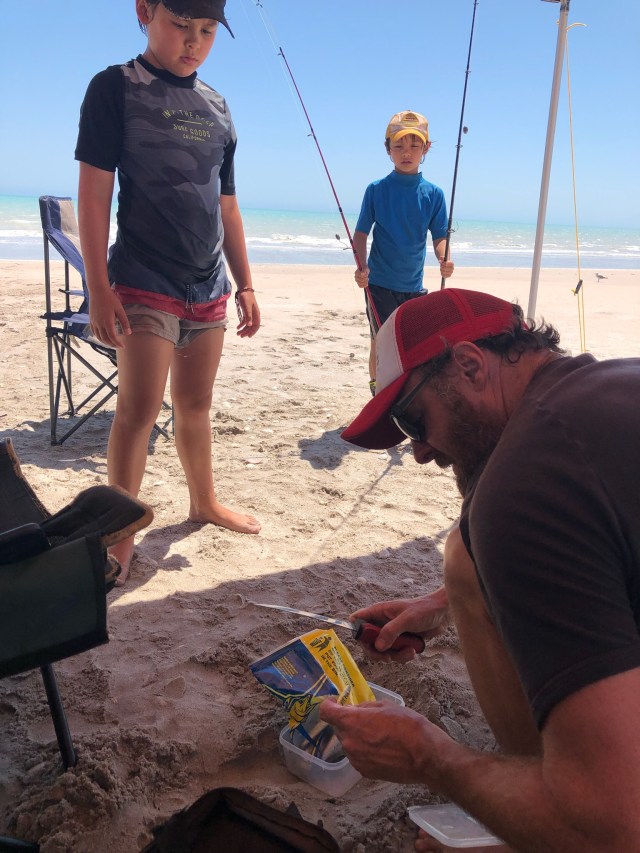
I sense them before I see them – that prickly feeling of being scrutinized. I glance up from my book and see two children, boy and girl, a couple of metres outside the shaded area. They stand together, side-by-side, shoulders almost touching. I am unsure how long they have been standing there, but they project an aura of patience, so it might have been a while. They both stare at the same point in space.
‘Hello’, I say.
‘Hi’. The girl speaks, the older of the two. She is thin, fair-haired and wears a light cotton pink dress with dusty bare feet. She is about eight and the boy around five.
‘I’m Poppy and this is Toby’, she continues, with confidence. Toby raises his left hand slightly, acknowledging both us, and his introduction. His mousy hair has blonde edges, faded by the sun, his skin is tan and he is wearing the uniform of the beach camping kid – rashy sun-shirt and little skinny shorts that are made of some material that is meant to dry quickly. They are the togs of those whose parents are still in complete control of wardrobe.
Sandi then introduces us along with the boys. With this, they walk in and sit.
Once I would have found this behaviour to be surprising. I probably would have been asking about the location of parents or at least looking around for some responsible adults. But this is not the first time this has happened, nor are we immune. Not long ago the boys disappeared only to surface playing UNO and nonchalantly sipping cordial with another family across the site.
We do the usual background travel conversation – where are they from, where have they been, where are they going?
As the conversation continues, the largely silent Toby remains cute and likeable. However, Poppy, while being thoroughly well-mannered and pleasant, unfortunately starts to irk me.
‘What’s this music?’ she asks, with an inflection on the word ‘music’. She doesn’t roll her eyes, but the delivery of this single word does the job. It’s clear that Bob Seeger hasn’t been rocking the little ears of Poppy recently. She doesn’t wait for a response.
‘You could play one of my Spotify playlists – there is coverage here so I could easily just look it up on the phone and play it’.
‘No’, I say, probably a bit quickly. She stares at me for a beat too long and the mood changes. I’ve been taken on by an eight-year old.
‘We’re vegan,’ she now announces. ‘We don’t eat meat or chicken or cheese or anything. We think even using animals as pets is cruel.’
‘Oh,’ I respond feebly, and feel a cool sweat break. After some gentle opening moves, Poppy is circling my Queen, and I’m helpless.
‘I’ve seen a megalodon’ says Toby, with what seems remarkable social awareness, knowing that observing thoroughly extinct mega-fauna should be enough to change the direction of a conversation.
‘Really… was it alive?’ I respond, hoping this piece of scientific tomfoolery will animate the little bugger.
I’m encouraged by the fact that although Toby doesn’t eat animals, he had declared earlier that he actually hates birds after being victim of the occasional swoop. He actually seems happiest chasing seagulls and pretending to assassinate them with whatever weapon a morally compromised five-year-old vegan uses.
But Poppy persists.
‘Have you been fishing?’ she asks.
Checkmate.
‘Yep’ I respond, and hope to leave it at that, but the ever helpful Eddie then chimes in and mentions we managed to hook a couple. He also adds some vivid detail of pulling them from the sea, the blood in the water, how they squirmed as they choked on air before we popped them back and they eventually swam off. Although, of course, they took a while to get going he concludes.
Poppy rolls her eyes towards me, and stares.
‘We think that fishing is cruel and we don’t do it,’ she pouts.
‘So… no danger of catching a megaladon at least,’ I offer insipidly.
Poppy chuckles, not in mirth but delicious victory.

 Big Country