The endless black ribbon stretches in front of us.
The Nullarbor Plain, an expanse cloaked in stories of endless nothingness, is an uninterrupted void topped with a highway that unravels flat and dead straight.
The road runs east from Western Australia, neatly meeting the inside of the Great Australian Bight near Eucla, just before the South Australian border. Here it tracks the sheer, vertiginous edge of Australia. Plummeting into the deep blue the wild eroded cliff faces, the obstinate perimeter of our land, stake their place in the surging water with breathtaking force.
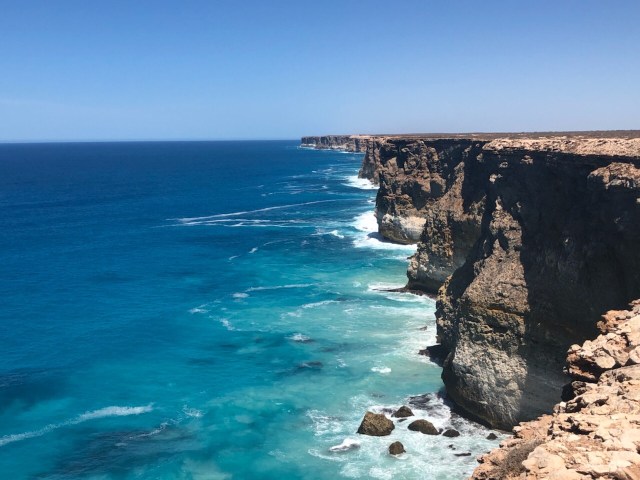
When I was a kid, I remember once going to a beach from our inland farm and seeing some rocky coastline, some little bay. I recall smugly thinking to myself ‘oh, that’s that bit that goes in on the map of Australia’, mistaking some non-descript stormwater outlet in Foster with the Bight. No mistaking this time.
While travelling this almost mythical section of road from west to east, it occurs to me that although it will be places, sights and experiences we talk about when we get home, stories that will become well worn, the road is actually the place we spend most of our time. Along the Nullarbor lie tiny communities, and I am reminded of the variety of towns, villages and hamlets we have encountered as we have travelled slowly around the country. At some we stop for lunch, hastened by flies or slowed by strange little shops full of oddities. Others we rumble straight through, just another car towing a trailer.
It’s impossible to get an accurate understanding of what places are really like with such a brief window into their existence, but it’s also impossible not to get a feeling. For some, it’s a sense of tiredness, a feeling that the time has past. Others renew and find different ways to continue, while others are fresh and shining with shimmering black rooftops side-by-side into the distance.
We’ve developed common phrases to describe the overall perceived prosperity of places as we have moved along. They are ‘looking good’ or ‘trying hard’, maybe ‘pretty quiet’ or the ultimate descriptor of a commercial nadir, ‘spooky’.
Speed limits can be a clue. If your town has slowly decreasing limits on its fringes – say from 110, to 80, to 60, to 50 and then, even 40, then you may well be in a flourishing locale. If, however, there is simply a reduction from 110 to 90, or worse still, no change at all, you’re in a small place that even road safety may have forgotten.
And so we come into Penong in the far west of South Australia. The map gives away little, just another dot near the end of the Nullarbor. However, as we approach, a sign tells us that Australia’s only windmill museum calls this little dot home, and we are instantly enthralled. This is the very type of civic innovation that we have come to admire, an indication of a town that hasn’t given up.
And so we wheel in, to a small paddock that is dotted with a wild assortment of windmills, the glistening silver blades circling slowly in the obliging warm breeze, the sun sparking off them as they turn. There’s a little shed with boards of information, revealing that the whole thing was born when the owners of the rural supplies shop and the caravan park decided the town needed something to grab traveller’s attention. Windmills were the obvious choice, with Penong having a history of reliance on the graceful spinning machines and their inherent pumping qualities due to the fact that it never bloody rains.
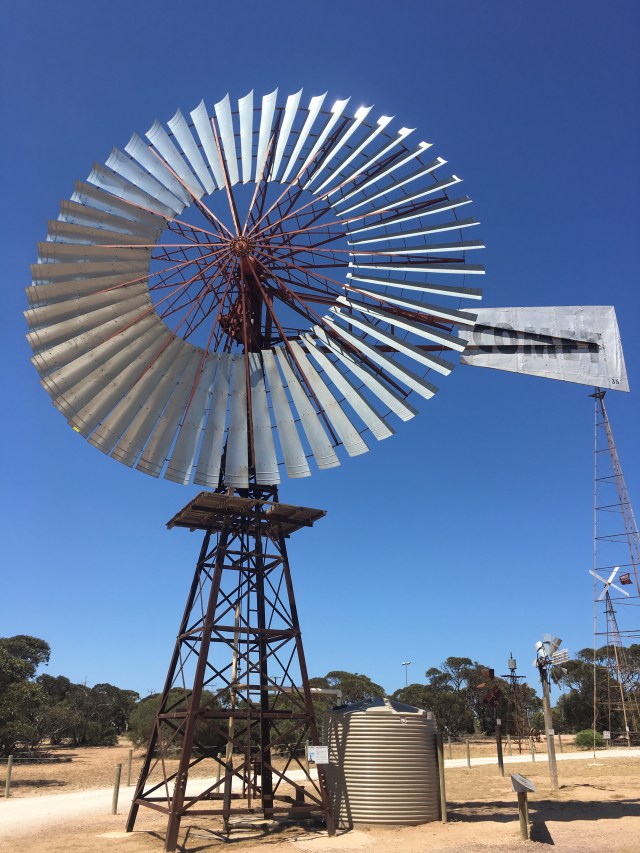
And so it began, and continues, and it’s wonderful. I am filled with nostalgia as I gaze up, reminded of the creaking machines we used to have on our old farm, held aloft by intricate towers of iron, rust brown. And the sound – they move slightly in the wind and the metal protests with a soft groan, there are small dings and dongs and the comforting soft whoosh of the hot breeze pushing it all.
And so Penong continues to live, nourished by lifeblood driven by the windmill ghosts turning in the middle of town. Of course, there are other factors that keep this town alive, but the spirit of community that something like this represents is obvious. Some towns feel like the love has left, the soul is broken and only the windswept shell remains. They are feather-thin and fragile. Others, like Penong, feel nurtured and needed, propelled by the hearts of those who call it home.


 Big Country
Great post 🙂
LikeLike
Thanks for reading.
LikeLike